Sabzeh
A childhood memory of Nowruz, 9/11, and what it means to listen before we prescribe.

March 1999. My mother came to school as my special guest.
I was in the third grade, just shy of nine years old, and I was beaming with excitement because it felt like the biggest moment of my life to date. Getting to share my personal hero with my class.
I was fairly new to that school, having started the semester before, while most of my classmates had known each other since kindergarten. Every day when homeroom began at 8:00 a.m., our teacher would go around and ask if we had anything to share with the class.
One morning, I raised my hand and told everyone that over the weekend, my mom and grandmother had taken my sister and me to the Persian market to gather everything for our haft-sin.
I thought everyone knew what a haft-sin was.
But as I spoke, I realized not everyone spent that weekend prepping a haft-sin as a family. Not everyone celebrated Nowruz, the Persian New Year. I remember feeling that tiny internal shift children get when they realize: oh. This is not normal here. This is just normal in my house.
After class, my teacher asked me if I wanted to invite my mom to come speak to the class about Nowruz and make a class celebration out of it. It felt like a big deal. I was shy, still trying to find my place socially, and part of me hoped this would be a bridge. Maybe I’d make new friends.
My mother said yes immediately. She was thrilled that the school was open to her sharing our culture with the students.
That day, I watched my mom speak in front of the whole class as she drew a map of Iran on the whiteboard.
“You will always find Iran on a map,” she said, “because it looks like a cat!”
To this day, when I spot Iran on a map, I can hear her voice saying it the same way.
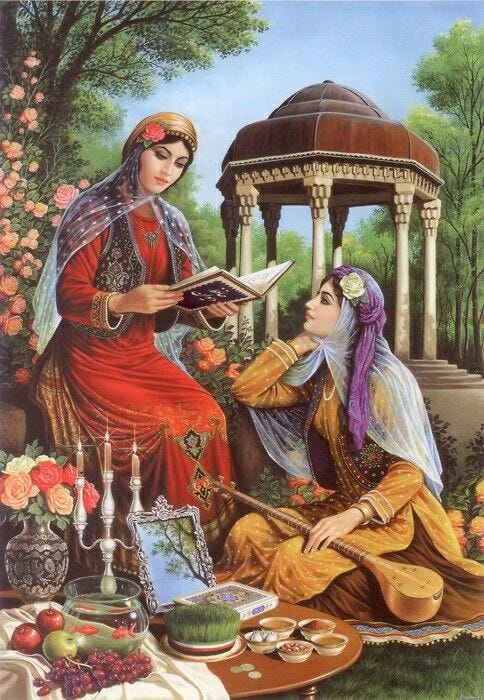
Then she laid out the haft-sin, composed of the seven symbolic items, each starting with the Persian letter “س” (seen): sabzeh (sprouts), samanu (wheat pudding), senjed (oleaster), seeb (apple), sir (garlic), serkeh (vinegar), and somagh (sumac). Each one held a wish. A symbol. A prayer for life and well-being.
My classmates got to touch the items and practice pronouncing each word. And of course, in my mother’s giving fashion, she brought Persian desserts to share with everyone, weaving in the beauty and mysticism of Persia’s ancient history through poetry, song, and story.
The school loved having my mom so much that they invited her back every year.
As a child, that was the version of America I knew: curious, open, eager to learn.
Then later, I met another version.
In 2001, I transferred to a new school. A Christian school.
I was raised Greek Orthodox, as my father is Greek-American, so going to church was not foreign to me. I actually loved church. I would find myself in a meditative trance listening to the Ancient Greek hymns, and it always felt like a place of mystery and wonder.
But this school was non-denominational Christian, and their version of church was a bit different. They called it “chapel,” and we collectively sang worship songs every Friday.
I was eleven years old. Puberty was tough. Being Persian and Greek, I had all the facial decorations: hair, acne, and eyes drowning in insecurity. My body was changing, and I was at a brand new school, and it didn’t feel good.
The teacher put the spotlight on me because I was new. She asked me to share a fun fact about myself.
I remember saying, carefully, that my mother was from Iran and that I spoke Farsi with her. I even added that maybe next spring I could invite my mom to share Nowruz with the class, the way she did at my old school.
The class didn’t seem interested. There was no curiosity. No questions.
And the teacher’s eyes widened, just for a moment, before she forced a smile and said, “That’s nice.”
Something in me registered that. Not intellectually. In my body.
September 11, 2001 was a Tuesday.
I went to school that morning not knowing that by the time the day ended, the world would feel like a different planet.
Our teacher canceled the lesson plan. She gathered us and spoke to us about terrorism and Islam.
I did not have the language then to name what was happening inside me, but I felt it. The way fear spreads. The way a story starts forming that needs a villain.
My mother picked me up from school that day and greeted me in Farsi.
To my peers, there was no difference between Farsi and Arabic, nor Persian and Arab, nor Iran and Iraq. It was all the same.
And I became the closest target they had.
Over the following months, something shifted around me. The air changed. Whispers became assumptions. Distance became a decision people made before they even knew me.
I didn’t understand why.
And at the same time, on Fridays in chapel, the youth pastor preached about forgiveness and then spoke about acts of terror “stemming from Muslims in the Middle East,” as if the region were a single organism, as if entire people could be reduced to one terrifying headline.
Nothing made sense.
That was my first identity crisis. I loathed that my mother came from a place that wasn’t accepted. I hated the way my own family suddenly felt suspicious to other people.
Those were dark days.
It is true: Christ spoke of forgiveness as the key to freedom. But in order to forgive, one must process, grieve, and heal. The process takes time.
And in the three years I was at that school, we never got to bring the haft-sin.
That was nearly twenty-five years ago.
I’m grateful that we live in a world where, in many places, diversity is celebrated and welcomed, and people genuinely care to know and understand where other people come from. I am proud of my Iranian heritage. I am proud to be the daughter of an Iranian immigrant who came to the United States, leaving her home behind, and boldly paving a way for her future daughters, my sister and me.
But what is happening in Iran today is devastating, and some truths must be acknowledged.
As much as everyone within Iran and its diaspora wants regime change, we have to understand and prepare ourselves for the kind of impact it may have if America inserts itself as the catalyst for that change.
This America we are witnessing reminds me of the school I attended from 2001 to 2003. A self-righteous ideology that preaches: we are right. If you abide by our ideologies, you are good. And if you exist outside them, you represent the antithesis of what we believe in.
I say “outside,” because on the inside we are all the same. The same fragile bodies. The same fear. The same longing to belong. The only difference is perspective, but perspective should never mean being better than, or more important than, someone else.
And from my own experience, some people do not know how to walk in other people’s shoes.
We are seeing it in Minneapolis, in my home city of Los Angeles, and across the United States. What’s being asked of people, and who is being labeled as “acceptable,” feels slippery and dangerous. It does not only touch criminals. It touches the “other.” It touches those who don’t fit a narrow bill of what “American” is supposed to look like.
The reality is, for me at least, I know a version of Iran that was my mother’s and my grandmother’s. Iranians within Iran are the ones on the ground fighting an extraordinarily corrupt and evil regime, for far too long.
It is easy for members of the diaspora to say, let America do its thing. But America, as it is today, is deeply troubled and divided too. Just the events of the past few days have people around the world in mourning and in fury.
I was speaking on WhatsApp with my friend in Iran. Her message was heartbreakingly clear:
“Please tell your friends to stop asking for American military intervention.”
She said life is already hard enough, and the thought of bombs falling on top of everything else is unbearable. Then she said something that forced me into her shoes: if people think war is the answer, they should move to Iran and be the targets themselves before they advocate for it.
It is easy to talk about regime change from the “safety” of the West, but we need to listen and support the people who will actually have to survive it.
Can we support each other without calling for further possible destruction?
Can we become a container for healing in the simplest ways, by being good and kind to one another, by listening before we prescribe?
As much as I hope for this reality, I know there is a long way to go. America must walk the walk before talking the talk. If tomorrow Iran’s current regime is overthrown, even by American military intervention, perhaps the world will celebrate. But beyond celebration, there must be time to process. Time to grieve. Time to respectfully choose the next steps with care, for the highest good of Iran and its people, including what a secular democracy might look like in Iran, shaped by the people who live there.
Beyond Iran, what about the world?
There are billions of us sharing one planet of culture, story, dreams, longing, and prayer. I think that’s phenomenal. When someone lives in their truth, they feel alive and expanded. Imagine that being the collective energy between all of us.
I dream about that sometimes.
Maybe it’s the child in me who still believes in what the haft-sin represents.
I don’t have the answer. Just a perspective.
All I can hope is that one day, soon, I’ll get to return to the Iran my mom once called home, and together we’ll create a new haft-sin.
Maybe the revolution begins when we stop asking for someone else’s bombs, and start asking how to hold one another through the rebuilding.
Praying that the US doesn’t blindly rush into conflict in Iran which causes more deaths and potentially a major war. 🙏🏻🙏🏻💔💔